

How Many Paragraphs Is an Essay? Understanding the Structure and Elements
When you’re asked to write an essay, one of the first things you might wonder is how many paragraphs should be in an essay? This is a common question that students face when approaching writing tasks, especially in academic settings. While there’s no one-size-fits-all answer, understanding the essay structure and the purpose of paragraphs can help you determine how many paragraphs are needed to effectively convey your message.
In this blog post, we’ll explore how many paragraphs in an essay are typical, with a focus on the five-paragraph essay as a foundation, and provide examples to guide your writing process. We will also look at the importance of paragraphs in structuring your essay, particularly focusing on the five-paragraph essay structure.
What Is a Five-Paragraph Essay?
A five-paragraph essay is a structured essay format that consists of five paragraphs: an introduction, three body paragraphs, and a conclusion. It is a widely used format for various types of essays, including argumentative, persuasive, and expository essays.
The five-paragraph essay format is popular because it’s simple, easy to follow, and helps to organize ideas logically. It provides students with a framework to develop their thesis statement and supporting arguments without overwhelming them with a complex structure.
The Five Paragraphs Essay Structure
To break down the five-paragraph essay format, here’s a typical essay structure:
- Introduction Paragraph: This is where you introduce the main idea of your essay. The introduction paragraph structure should begin with a hook to grab the reader’s attention, followed by some background information, and then the thesis statement, which presents the central argument of your essay.
- Body Paragraphs: There are three body paragraphs in a five-paragraph essay. Each body paragraph serves to elaborate on a specific point supporting your thesis. The topic sentence of each body paragraph introduces the main point of the paragraph, followed by supporting details and examples. Transitions between paragraphs help maintain a smooth flow of ideas.
- Conclusion Paragraph: This is the final paragraph of your essay. It should restate the thesis, summarize the key points made in the body paragraphs, and leave the reader with a final thought or call to action.
This structure ensures that your essay writing is well-organized and each paragraph is focused on a specific idea.
How Many Paragraphs Are in an Essay?
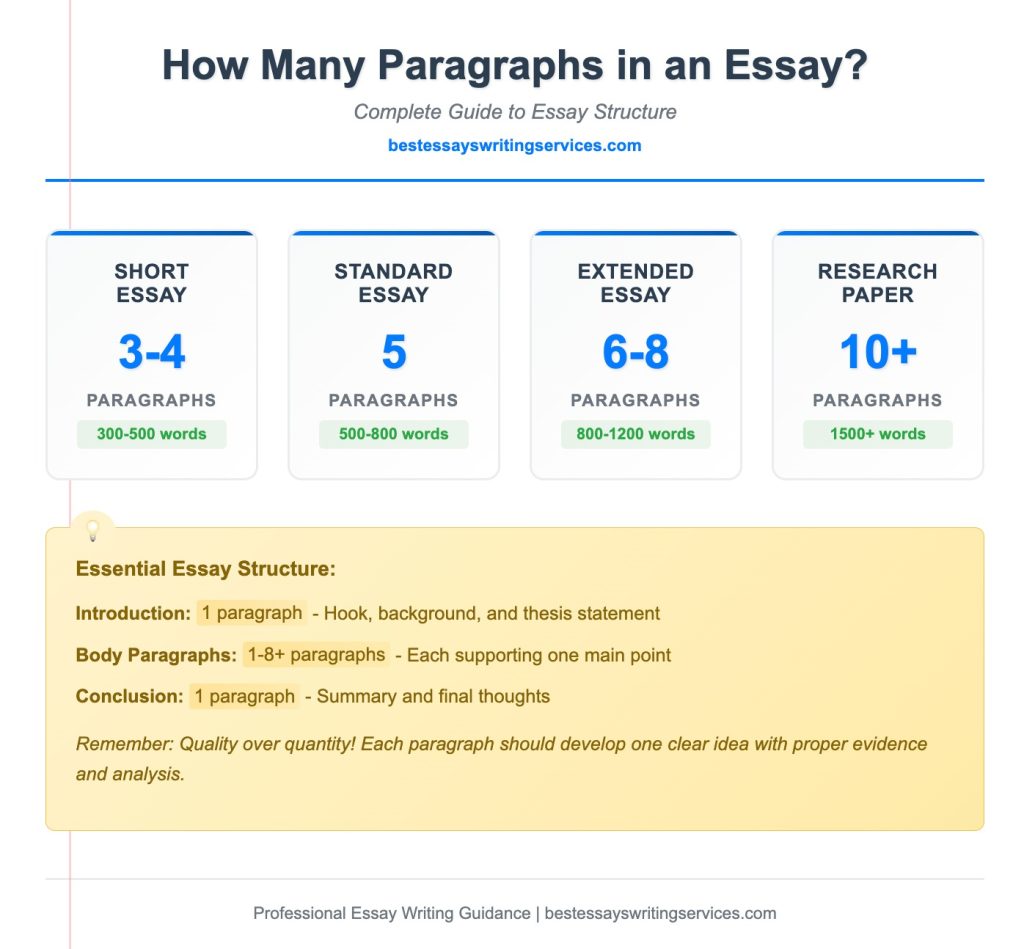
When considering how many paragraphs in an essay, it ultimately depends on the type of essay you’re writing and the length required by your instructor. While a five-paragraph essay is common, essays can have more or fewer paragraphs depending on the complexity of the topic and the word count.
For example:
- Five Paragraphs: This is a standard structure for short essays, especially for elementary, middle school, or introductory college-level writing. These essays are typically used to teach students the basics of essay structure.
- More Than Five Paragraphs: Research papers, college essays, and complex topics often require more than five paragraphs. These essays can range from six paragraphs to several pages, depending on the topic and the word limit set by the assignment. In these essays, you may have multiple body paragraphs and a more detailed introduction and conclusion.
- Fewer Paragraphs: If you are writing a brief response or persuasive essay with a strict word limit, you might end up with fewer paragraphs, focusing on getting straight to the point and ensuring each paragraph is concise.
The Role of the Body Paragraphs
In a five-paragraph essay, the three body paragraphs each serve an important purpose:
- First Body Paragraph: This paragraph typically presents your first supporting point. After introducing your argument in the introduction, the first body paragraph expands on your thesis by providing the first piece of evidence or a key example to support it.
- Second Body Paragraph: The second paragraph usually contains the second supporting point. This paragraph should continue the argument and provide additional details and examples that strengthen your case.
- Third Body Paragraph: The third body paragraph introduces the final supporting point. This paragraph may also address counterarguments or alternative perspectives, followed by a rebuttal that further supports your thesis.
Each body paragraph should follow a clear structure with a topic sentence and supporting details that fully develop the point.
What Is the Word Count for an Essay?
The word count can significantly influence the number of paragraphs in an essay. A short essay may have only five paragraphs and be between 300 and 500 words, while longer essays or research papers will likely require more paragraphs to meet a larger word count.
For example:
- A typical five-paragraph essay could range from 300 to 500 words.
- A college essay might require 7-10 paragraphs and be about 1000-1500 words.
- A research paper could be longer and involve more detailed analysis, with multiple body paragraphs.
Each paragraph in a longer essay will be slightly longer, as you elaborate on the topic in more detail to meet the word count.
The Structure of a Five-Paragraph Essay: Writing Tips & Essay Format
When writing a five-paragraph essay, here are some writing tips to make sure your essay format is effective:
- Introduction: Start with an attention-grabbing sentence to pique the reader’s interest. Make sure the thesis statement clearly outlines the main point of the essay and indicates the structure of the essay.
- Body Paragraphs: Each body paragraph should focus on a single main idea related to the thesis statement. Begin each paragraph with a topic sentence, and make sure each paragraph includes supporting details and examples. Use transitions to ensure the flow of ideas between paragraphs.
- Conclusion: Summarize the main points discussed in the essay and restates the thesis in a fresh way. End with a strong concluding sentence that wraps up the essay and leaves the reader with something to think about.
How to Write an Essay: Structuring Your Ideas Effectively | Typical Essay Structure
Writing an essay involves organizing your thoughts in a structured way to effectively convey your message. The typical essay structure includes an introduction, a series of body paragraphs, and a conclusion. Each section has a specific purpose: the introduction for an essay grabs the reader’s attention, the body paragraphs support the thesis, and the last paragraph wraps up the discussion.
Understanding how to write an introduction for an essay is key to making your argument compelling from the start. The introduction should introduce the topic, provide context, and lead to your thesis statement, setting up what the reader can expect in the essay.
Writing a Five-Paragraph Essay: A Simple Formula for Success
The five-paragraph essay is a common format for essays, especially in college essays or exams. It consists of an introduction paragraph, three body paragraphs, and a conclusion paragraph. This structure helps in organizing thoughts clearly, making it easier for the writer to present their thesis and supporting arguments. When writing a five-paragraph essay, you have a clear format to follow, which is great for those who are unsure about where to start.
The body paragraphs typically each focus on one point and build up the argument with supporting details, while the conclusion summarizes the points made and restates the thesis in a fresh way.
The Importance of Transitions in Essay Writing
When writing an essay, it’s important to transition smoothly between paragraphs. A good transition allows the reader to follow your ideas seamlessly from one paragraph to the next. Each body paragraph should start with a topic sentence and use transitions to connect with the previous paragraph. Transitions help the essay flow logically and ensure that each body paragraph supports your thesis without jumping from one idea to the next abruptly.
The Different Kinds of Essays and Their Structure
There are different kinds of essays, such as argumentative, expository, and descriptive essays, and each requires a specific essay format. For example, in a persuasive essay, you’ll use facts and reasoning to convince your reader of your argument, while in an expository essay, you’ll focus on explaining a concept or idea clearly.
Understanding the three parts of an essay—introduction, body, and conclusion—is essential when writing different kinds of essays. While the structure may vary slightly based on the essay type, each section serves a critical function in ensuring your message is clear and well-supported.
How Many Paragraphs Are in an Essay? Understanding Essay Length
The number of paragraphs in an essay can vary depending on the type of essay and word count. For a typical essay structure, you may have three paragraphs for a shorter essay or five paragraphs for a more standard format. However, longer essays, like college essays, may require many paragraphs to fully develop the ideas and support your thesis.
How Many Sentences in a Paragraph? Understanding Essay Structure
One common question when writing an essay is: how many sentences in a paragraph? Typically, each paragraph in an essay should consist of three to five sentences, depending on the word count and the complexity of the topic. Each paragraph should present a clear idea, starting with a topic sentence, followed by supporting sentences that explain or expand on that idea, and ending with a concluding or transitional sentence.
For a college essay, paragraphs can vary in length, but it’s important to maintain clarity and conciseness. Avoid too many short paragraphs or making each paragraph too long. The goal is to create well-developed paragraphs that fully support your thesis and keep your reader engaged.
Introduction for Essay: Setting the Stage for Your Argument
The introduction for an essay is your first opportunity to engage the reader and set up the argument you are about to present. A good introduction grabs the reader’s attention, introduces the topic, and provides background information that leads to the thesis statement. The thesis should be clear and concise, as it will guide the rest of your essay.
When crafting an introduction, it’s important to strike the right balance: not too short, but not overly long. Two paragraphs might be appropriate for a more detailed introduction, especially in a college essay, but remember to stay focused on the purpose of setting up your main idea.
Not Sure How Many Paragraphs Your Essay Should Be?
Understanding the right essay structure is crucial to crafting a well-organized and compelling piece. Whether you’re writing a five-paragraph essay or a more extensive research paper, BestEssaysWritingServices.com is here to help you every step of the way!
What is a Conclusion in an Essay? Wrapping Up Your Argument
The conclusion in an essay is the final opportunity to leave a lasting impression on the reader. It should briefly summarize the main points discussed, restate the thesis in light of the evidence presented, and provide some final thoughts. While the introduction grabs the reader’s attention, the conclusion ensures that your ideas are neatly tied together, leaving the reader with something to reflect on.
If you’re writing an essay and you’re not sure what to include in your conclusion, focus on reaffirming your argument and the key insights you’ve provided. You don’t need to introduce new information; rather, aim to provide a final perspective on the topic that ties back to your main argument.
Many Paragraphs in an Essay: How Much Depth Should You Go Into?
As you draft your essay, it’s important to understand how many paragraphs an essay needs. A college essay or research paper may have many paragraphs to ensure a thorough exploration of the topic. The number of paragraphs depends largely on the words per paragraph and the overall word count of the essay.
If the essay is shorter, such as a 500-word essay, you may only need five paragraphs—the standard five-paragraph essay format with an introduction, three body paragraphs, and a conclusion. However, in a longer essay or research paper, it’s typical to have many paragraphs. Here, each paragraph should fully develop one point or argument and contribute to the overall structure of your essay format.
Writing a College Essay: Balancing Short and Long Paragraphs
When writing a college essay, it’s important to balance the length of your paragraphs. If you’re unsure of how to approach it, aim for one paragraph that introduces your thesis, followed by several body paragraphs that expand on your arguments, and then a conclusion that wraps up the discussion. However, avoid too many short paragraphs that don’t develop the ideas sufficiently.
In general, two paragraphs might suffice for brief sections in the body, but ensure that each paragraph is focused and fully develops its point. Too many short paragraphs may weaken the overall coherence of your essay. The words per paragraph should allow for the complete explanation of a specific point, giving the reader a clear understanding of your argument.
By keeping these elements in mind—how many sentences in a paragraph, creating a good introduction, and understanding what is a conclusion in an essay—you can develop a well-organized essay that effectively conveys your ideas. Whether you’re writing a five-paragraph essay or a more complex essay, focusing on the structure and ensuring each section is clear and focused will help you present your argument in a compelling way.
Writing Three Paragraphs or More: Determining the Right Length
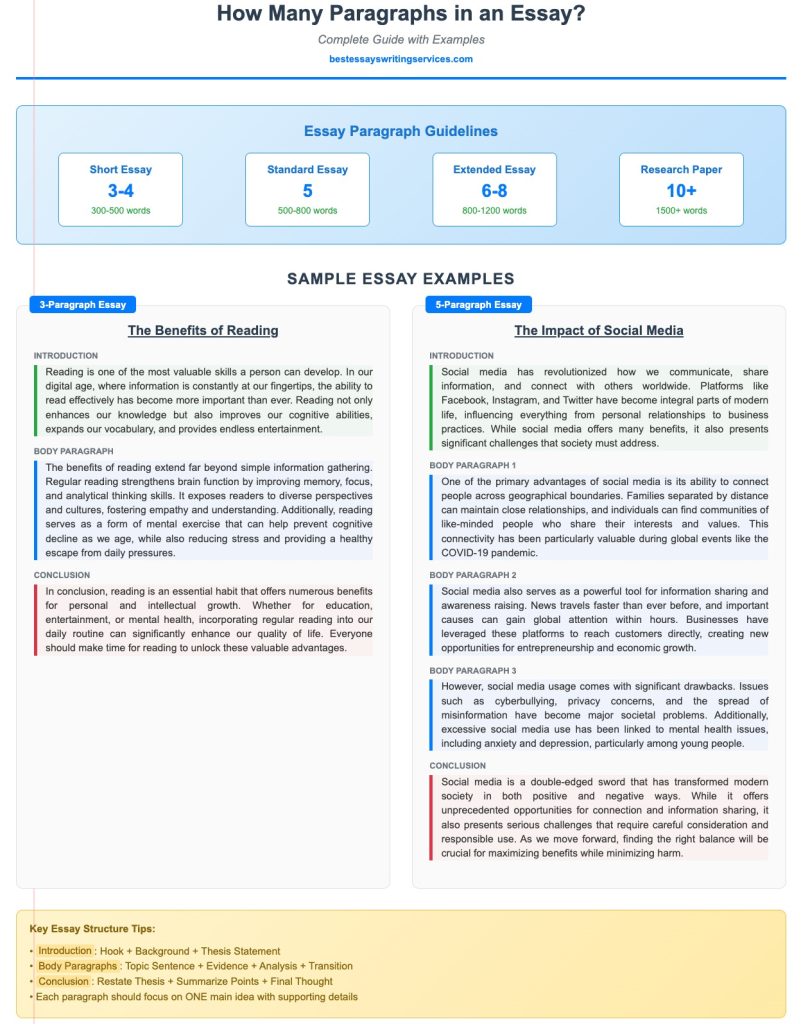
In some cases, you may be asked to write an essay with just three paragraphs—one for the introduction, one for the body, and one for the conclusion. However, for most academic essays, the standard is often five paragraphs. Each body paragraph should be developed with enough detail to support the thesis. The length of your essay will depend on the word limit and the number of ideas you need to cover, but a typical essay structure includes three parts: introduction, body, and conclusion.
Crafting a Strong Ending for Your Essay
The conclusion in an essay is essential for summarizing the key points discussed and reaffirming the main argument. A good conclusion not only restates the thesis but also summarizes the key supporting points from each body paragraph. It’s the last paragraph, so it should leave a lasting impression on the reader. Whether you’re wrapping up a short three-paragraph essay or a more complex research paper, the conclusion should provide a sense of closure while also giving the reader something to think about.
By following this guide to writing a five-paragraph essay or a more extensive research paper, you can ensure that your essay is well-organized, concise, and effective. Understanding the typical essay structure and practicing brainstorming will help you craft a compelling essay that clearly communicates your ideas to the reader.
Conclusion: How Many Paragraphs in an Essay?
In general, the number of paragraphs in an essay depends on the type of essay and its requirements. A five-paragraph essay is a basic structure that provides a simple framework for introducing an argument, supporting it with evidence, and concluding with a final thought. More complex essays and research papers may involve more paragraphs to delve into deeper analysis and provide comprehensive coverage of a topic.
Remember that the key to a compelling essay lies not just in the number of paragraphs, but also in how well each paragraph is developed and how they contribute to the overall argument. Understanding the typical essay structure and adhering to the essay format will help you craft well-organized and coherent essays, no matter the length or complexity.
Start Writing Your Perfect Essay Today! and learn how to effectively structure your paragraphs and convey your ideas with clarity and precision.
FAQs about How Many Paragraphs Is an Essay: Best College Essays
1. Is an Essay 3 or 5 Paragraphs?
An essay can be both 3 paragraphs or 5 paragraphs, depending on the type of essay and its requirements. A three-paragraph essay is generally used for shorter essays or those focusing on a specific paragraph with limited elaboration, while a five-paragraph essay is more typical for short academic assignments. A five-paragraph essay usually includes:
- Introduction (1st paragraph)
- Body paragraphs (3rd paragraphs, each covering a different supporting point)
- Conclusion (1st final paragraph)
For longer essays or complex issues, the number of paragraphs can vary depending on the word limit and the specific paragraph structure needed to address the topic fully.
2. How Many Paragraphs is a Full Essay?
A full essay can range from 3 paragraphs to multiple paragraphs depending on the length and depth of the topic being discussed. For a short essay, especially one in response to an assignment with a word count such as 500 words, a three-paragraph format might suffice. However, for more comprehensive assignments, such as college essays or research papers, an essay could have 6 paragraphs or more.
The five-paragraph essay outline is a common and formulaic structure that includes an introduction, three body paragraphs, and a conclusion. In college essays, longer essays might have many paragraphs because the writer’s point of view often requires more room to elaborate.
3. Should a 500-Word Essay Have Paragraphs?
Yes, a 500-word essay should have paragraphs. The paragraphs in an essay provide structure and clarity to your writing. A typical 500-word essay might be 3 to 5 paragraphs, with each paragraph serving a specific purpose. Here’s a common way to structure a 500-word essay:
- Introduction (1 paragraph, around 50-100 words)
- Body paragraphs (2-3 paragraphs, around 150-200 words each, depending on the number of points you’re discussing)
- Conclusion (1 paragraph, around 50-100 words)
Each paragraph should have multiple sentences and focus on one point that supports the thesis. The first sentence of each body paragraph should introduce the main idea, while the rest of the paragraph provides supporting details.
4. How Long Should an Essay Be?
The length of an essay depends on the kind of essay you’re writing and the specific requirements given by your instructor. Generally, essays can range from short assignments like 3 paragraphs to more complex ones with 6 paragraphs or more, depending on the word count and the complexity of the topic.
- Short essays might require as few as three paragraphs.
- Medium-length essays, like a 500-word essay, could have around 5 paragraphs (introduction, 3 body paragraphs, and conclusion).
- Longer essays (such as college essays or research papers) can have many paragraphs and detailed content spread across a higher word count.
The length will also vary depending on the specific paragraph structure you need, whether it’s a persuasive, argumentative, or descriptive essay. You’ll need room to elaborate on your points, and the essay should be structured to allow you to summarize the points at the end with a strong conclusion.

